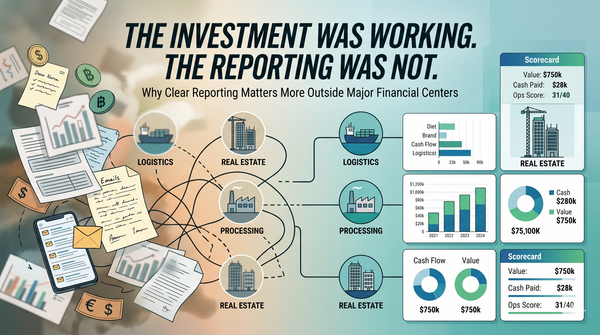

A family can inherit millions and still be unable to touch the money.
That sounds impossible. It is not.
A cross-border investor may own private company shares, secured loans, property, brokerage accounts, and a holding company. The heirs may know those assets exist. But banks, courts, trustees, and company registries usually need proof.
No proof means delay.
The original draft described a family that spent 14 months reconstructing missing documents after a death. That is plausible as a planning risk, but the exact case is not independently verified. So this rewrite treats it as a representative example, not a reported case.
The explanation
Wealth is not just what you own. It is what your family can prove you own.
For public stocks, proof is usually simple. The brokerage account has a statement. The custodian has records.
Private wealth is different.
A private company share may need a share certificate, shareholder register, board records, and beneficial ownership filing. A secured loan may need the signed loan agreement, collateral agreement, and proof that the lien was registered. A foreign property may need a title deed, tax record, registry extract, and certified translations.
That is why families need a Records Vault.
A Records Vault is a secure, organized library of the documents that prove ownership, control, debt claims, tax status, and banking authority.
This is becoming more urgent because private wealth is growing more global and more structured. Reuters reported in September 2025 that DBS’s Singapore-based multi-family office platform reached S$1 billion, about US$780 million, in assets under management within two years of launch. The bank said families were seeking more certainty in a volatile global environment.
The risk is not only family confusion. Banks and regulators are also asking more questions.
In July 2025, Singapore’s Monetary Authority penalised six banks and three other financial institutions a total of S$27.45 million after anti-money-laundering failures tied to Singapore’s 2023 money-laundering case. Reuters reported that MAS cited weaknesses in risk assessments and transaction monitoring.
That matters for legitimate families too. When records are incomplete, institutions often pause first and ask questions later.
The real-world picture
Imagine a founder dies with US$8 million in cross-border assets.
The family believes the estate includes:
A 40% stake in a private operating company.
US$1.5 million in secured loans to three borrowers.
Two apartments in Eastern Europe.
A European brokerage account.
A Gulf holding company.
The heirs know the assets exist. But the bank asks for certified copies. The company lawyer asks for signed shareholder records. The borrower asks for proof that the loan was transferred to the estate. The property registry asks for translated and certified documents.
Now the family has a problem.
The wealth is real, but the paper trail is weak.
One missing document can delay cash flow. Three missing documents can start a dispute. A missing lien registration can weaken a creditor claim.
This is not just an emerging-market problem. The World Bank’s B-READY 2025 data found a large gap between written rules and public-service delivery. Across 101 economies, public services and transparency scored an average of 43 out of 100, compared with 68 for regulatory quality and operational efficiency.
Plain English: the law may say the process exists, but the actual registry, platform, timeline, or verification step may still be hard to use.
Family offices are noticing the same operational problem. BNP Paribas and Campden Wealth’s Asia-Pacific Family Office Report 2025 surveyed 76 family offices, with average family wealth of US$1.3 billion. The report said spreadsheet over-reliance and manual processes had become top operational concerns, and that demand was rising for real-time financial platforms and cloud-based document management.
The risk reality
A Records Vault does not solve every estate problem.
It does not replace a will. It does not replace a trust deed. It does not remove local court requirements. It does not guarantee that a foreign bank will accept a document immediately.
It reduces friction.
The first risk is outdated paperwork. A share certificate from 2017 may not match the current shareholder register. A passport copy may have expired. A director appointment may never have been filed.
The second risk is cross-border recognition. A document that works in one country may need notarisation, legalisation, apostille, translation, or local counsel review in another country. The Hague Apostille Convention simplifies the use of public documents abroad by replacing traditional legalisation with a single apostille certificate, but local acceptance rules still matter.
The third risk is beneficial ownership. This means the real person who owns or controls a company, trust, or account. FATF guidance says countries and the private sector need adequate, accurate, and up-to-date beneficial ownership information for trusts and similar legal arrangements.
Reuters also reported in September 2025 that FATF will focus heavily on whether company registers are effective and whether ownership information is updated, complete, accurate, and available to authorities.
The fourth risk is family conflict. J.P. Morgan’s 2026 Global Family Office Report found that 41% of business-owning families named internal conflict as a top-three risk. The same report said 66% of business-owning families had formal constitutions or written bylaws, compared with about 50% of non-business-owning families.
Documents do not remove emotion. But they can stop emotion from becoming paralysis.
The action step
In the next 30 days, build a first Records Vault Index.
Do not start with software. Start with a list.
For every asset, record the asset name, country, legal owner, current value estimate, key documents, storage location, adviser contact, and renewal date.
Then collect seven core files.
Ownership records.
Debt agreements.
Security or lien registrations.
Corporate records.
Banking and signatory files.
Tax filings and residency certificates.
Insurance and valuation reports.
After that, ask your lawyer, banker, and tax adviser one direct question:
“What document would my family need first if I died or became incapacitated tomorrow?”
Put the answer in the vault.
Then set one annual review date. A vault that is not updated is just an archive.
The Family Office Lite rule is simple: ownership unproven is ownership delayed.
Global Wealth Diagnostic
The Global Wealth Diagnostic is a fast, personalized diagnosis that helps high earners identify the smartest next steps for building wealth across borders. It evaluates your current position, highlights your biggest opportunities and gaps, and gives you a practical roadmap for investing, structuring, and moving with more confidence.
Sources
Original contributor draft supplied to I-Invest.
Reuters, September 23, 2025: DBS-backed family-office platform reaches S$1 billion in assets under management.
Reuters, July 4, 2025: MAS penalties against nine financial institutions for anti-money-laundering breaches.
World Bank, March 30, 2026: B-READY 2025 data on business location services and public-service delivery gaps.
BNP Paribas and Campden Wealth, Asia-Pacific Family Office Report 2025, released March 9, 2026.
FATF guidance on beneficial ownership and transparency of legal arrangements.
Reuters, September 3, 2025: FATF focus on company registers and beneficial ownership transparency.
J.P. Morgan Private Bank, 2026 Global Family Office Report.
HCCH guidance on the Apostille Convention.
Disclosure
This article is general information, not personal investment, tax, or legal advice. It reflects conditions and data available as of April 2026. I-Invest Magazine and the author do not receive compensation from entities mentioned unless explicitly stated. Readers should obtain independent professional advice before taking action.
Written by