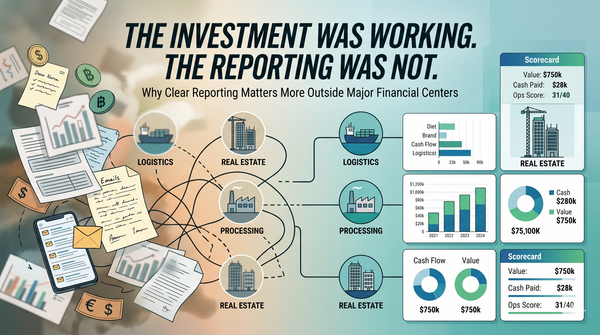

A founder dies. The family expects the next dividend from the holding company. Instead, the bank asks a simple question: “Who really owns this company now?”
The corporate registry shows two relatives and one old nominee shareholder. The shareholder agreement shows something different. The beneficial ownership declaration has not been updated. No one is accused of wrongdoing, but the bank pauses transfers until the records match.
That is the new reality. Beneficial ownership means the real human beings who ultimately own or control a company. Global rules now expect this information to be accurate, current, and available to authorities, not buried in old side agreements. FATF strengthened its company ownership standard in 2022 and issued updated guidance in March 2023.
The explanation
Think of a company like a locked box. The registry shows the name on the box. The bank wants to know who has the key.
A beneficial owner is usually the person who owns, controls, or benefits from the company. In the UAE, Cabinet Decision No. 109 of 2023 treats a person with direct or indirect ownership or voting rights of 25% or more as a beneficial owner. It also requires legal persons to keep adequate, accurate, and up-to-date beneficial ownership data.
This matters because banks do not look at one document. They compare the company registry, bank records, shareholder agreements, tax filings, nominee arrangements, and estate documents. If those records tell different stories, the bank may escalate the file.
The pressure is rising. The EU adopted a major anti-money laundering package in May 2024. It regulates beneficial ownership, tightens due diligence, and creates a new EU anti-money laundering authority. Regulation (EU) 2024/1624 was published in June 2024 and applies from 10 July 2027, with some entities delayed to 2029.
This is not only Europe. The OECD’s 2024 report to the G20 says beneficial ownership transparency is central to fighting tax evasion and illicit financial flows.
The real-world picture
Imagine a family holding company owns a $6 million stake in a property business. The company expects a $300,000 annual distribution.
The founder dies. The registry still lists the founder and a nominee. The family agreement says the founder’s two children now own the shares. The bank file still shows the founder as the controlling person.
The money is real. The ownership story is not clean.
The bank may ask for a new ownership chart, death certificate, probate documents, updated shareholder register, board resolution, and notarized beneficial ownership declaration. Until that package is complete, the $300,000 distribution may sit unpaid.
For a family, that can mean delayed school fees, missed loan payments, or a frozen investment plan. For a founder, it can mean a blocked exit or delayed funding round. For an investor, it can mean being unable to prove who has the right to dividends or voting power.
The risk reality
Clean ownership records reduce friction. They do not guarantee approval.
A bank can still pause activity if there are sanctions concerns, unexplained source of funds, political exposure, tax mismatches, nominee confusion, or family disputes. Financial institutions use due diligence tools and questionnaires to standardize how they assess counterparties and ownership risk. The Wolfsberg Group says its due diligence questionnaires are a global standard for financial institutions in correspondent banking relationships.
The biggest practical risks are simple:
First, side agreements that never reach the registry.
Second, nominee shareholders who are no longer active or properly documented.
Third, a death, transfer, or capital increase that changes ownership but is never reported.
Fourth, tax filings that show one structure while bank records show another.
Fifth, different ownership records across several countries.
The U.S. also shows why investors must check rules by jurisdiction. FinCEN changed its beneficial ownership reporting position in March 2025. Domestic U.S. entities are now exempt from federal BOI reporting, while certain foreign entities registered to do business in the U.S. may still have filing duties.
The lesson is not that one rule applies everywhere. The lesson is that every structure needs a current paper trail.
The action step
In the next 30 days, do three things.
First, create a one-page ownership map. Show every company, trust, foundation, nominee, shareholder, voting right, ownership percentage, country, and currency.
Second, reconcile the ownership map against five documents: the corporate registry, bank KYC file, shareholder agreement, tax records, and succession documents.
Third, ask a licensed lawyer, accountant, or corporate secretary to confirm filing deadlines in each jurisdiction. For UAE entities, note the 15-day update requirement for changes to beneficial ownership data under Cabinet Decision No. 109 of 2023.
Use the I-Invest Ops Readiness Scorecard to grade five areas: entity stack clarity, document survivability, succession continuity, banking durability, and reporting controls.
Pull quote: Ownership confusion is a compliance trigger.
Sources
FATF, “Guidance on Beneficial Ownership of Legal Persons,” published 10 March 2023.
UAE Ministry of Economy, Cabinet Decision No. 109 of 2023 on Beneficial Owner Procedures.
Council of the European Union, “Anti-money laundering: Council adopts package of rules,” 30 May 2024.
Regulation (EU) 2024/1624, published in the Official Journal of the European Union on 19 June 2024, applying from 10 July 2027, with certain provisions from 2029.
OECD and Global Forum, “Beneficial Ownership and Tax Transparency: Implementation and Remaining Challenges,” 2024 report to G20 Finance Ministers and Central Bank Governors.
FinCEN, “Beneficial Ownership Information Reporting,” updated March 2025.
Wolfsberg Group, correspondent banking due diligence resources.
Disclosure
This article is general information, not personal investment, tax, or legal advice. It reflects conditions and data available as of April 2026. I-Invest Magazine and the author do not receive compensation from entities mentioned unless explicitly stated. Readers should obtain independent professional advice before taking action.
Written by