When an Inheritance Plan Fails, It Is Usually Not Because of the Will
The Hook
A founder spent 20 years building wealth across five places.
He had an operating business in West Africa, a holding company in the UAE, property in Eastern Europe, a brokerage account in Europe, and private credit notes in Southeast Asia.
He also had a will.
Then he died unexpectedly.
The will said who should inherit what. But it did not answer the urgent questions banks, partners, vendors, and tax authorities needed answered that week.
Who could sign? Who could manage the business? Who could speak to the bank? Who could keep filings current?
Within days, two accounts were frozen. Vendors became nervous. Minority partners asked who was in charge. Tax deadlines were still moving.
The family’s problem was not a fight over money.
The problem was that the estate had no operating system.
The Explanation
Most people think inheritance is about who gets the assets.
That is only half the story.
For cross-border families, inheritance is also about who has authority to keep things working while the legal process catches up.
A will is a set of instructions. It usually matters after death. But banks, companies, property registries, and courts may still require formal proof before they act.
That process is called probate. In plain English, probate is the legal confirmation that a person’s will is valid and that someone has authority to handle the estate.
In one country, that may be straightforward. Across several countries, it can become slow and expensive.
The European Union created succession rules to make cross-border inheritance easier for participating member states. Those rules apply to deaths on or after 17 August 2015 and allow one authority and one law to handle many cross-border succession matters. They do not cover inheritance tax, and Denmark and Ireland do not participate.
That matters because many wealthy families do not hold assets in one clean place.
They hold assets through companies, trusts, foundations, special purpose vehicles, brokerage accounts, property titles, and private deals.
Each one may have different rules.
A bank may need probate documents before allowing a new signer. A company may need a board resolution. A regulator may need current beneficial ownership records, which identify the real person who owns or controls a company. FATF’s 2023 beneficial ownership guidance stresses that countries should ensure company ownership information is adequate, accurate, and up to date.
This is why inheritance can fail even when the family gets along.
Good intentions cannot replace missing authority.
The Real-World Picture
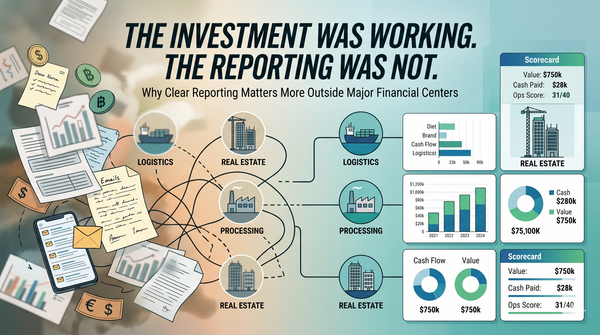
Imagine a family has a $5 million cross-border portfolio.
It includes:
$1.5 million in an operating business
$1 million in real estate
$1 million in a brokerage account
$750,000 in private credit notes
$750,000 held through a foreign company
Now imagine the founder was the only bank signer for the operating business.
Payroll is due in 14 days. A tax filing is due in 30 days. A supplier must be paid before releasing inventory.
The will names the spouse and children as heirs. But the bank cannot act on emotion or family agreement.
It needs documents.
The company also has a problem. The founder was the only director with practical control. The shareholder agreement does not say who steps in during death or incapacity.
So the business does not collapse because the assets vanished.
It weakens because nobody has clear authority to move money, sign papers, or reassure partners.
This is the core lesson.
A family office is not only for billionaires. A “Family Office Lite” setup means a simpler system that keeps records, authority, banking access, reporting, and succession clear.
For a cross-border family, that system can be the difference between a smooth transition and a frozen estate.
The Risk Reality
This planning does not remove all risk.
Inheritance laws can conflict. A will recognized in one country may need extra steps in another. Tax rules can also vary widely, and the OECD found major differences in how countries design inheritance, estate, and gift taxes.
Banks may still freeze accounts if documents are unclear. That is not always hostility. Banks are trained to avoid fraud, sanctions breaches, and unauthorized transfers.
Governance risk is also real. The World Bank’s 2024 Worldwide Governance Indicators cover 214 economies and measure issues such as rule of law, regulatory quality, and government effectiveness. Those factors matter when families depend on courts and registries across countries.
There is also an operational risk.
The Basel Committee says banks need resilience so they can keep critical operations working through disruption. Families should think the same way. If one person’s death stops all signatures, reporting, and decision-making, the family has a fragile system.
The biggest mistake is waiting until wealth becomes complex.
By then, the family may already have companies, accounts, properties, and private deals spread across several legal systems.
That is when a simple will is no longer enough.
The Action Step
In the next 30 days, cross-border investors should complete an inheritance continuity review.
Start with one document that lists every major asset, the legal owner, the country, the bank or custodian, the signer, the successor decision-maker, and the governing law.
Then ask a licensed estate lawyer and tax adviser to review three items: whether the will is recognized where the assets sit, whether company documents allow interim management, and whether tax and corporate filings can continue after death or incapacity.
Finally, speak to each major bank or custodian and ask one practical question: “What documents would you require if the current signer died or became incapacitated?”
Do not ask this only in theory.
Get the answer in writing where possible.
A useful scorecard should cover five areas, each scored from 0 to 5:
Succession and continuity
Entity structure clarity
Document survival and access
Banking durability
Reporting and controls
A score below 3 in any area deserves professional review.
The goal is not to control the future perfectly.
The goal is to make sure the estate can keep moving when the founder no longer can.
“Inheritance fails when structure stops working.”
Sources
Supplied I-Invest draft on cross-border inheritance continuity.
European e-Justice Portal, “Succession,” updated 4 April 2024.
OECD, “Inheritance Taxation in OECD Countries,” 2021.
FATF, “Guidance on Beneficial Ownership of Legal Persons,” 2023.
World Bank, “The Worldwide Governance Indicators: Methodology and 2024 Update,” published 7 November 2024.
Basel Committee on Banking Supervision, “Principles for Operational Resilience,” published 31 March 2021.
Disclosure
This article is general information, not personal investment, tax, or legal advice. It reflects conditions and data available as of April 2026. I-Invest Magazine and the author do not receive compensation from entities mentioned unless explicitly stated. Readers should obtain independent professional advice before taking action.