The Mobility Class Insurance & Risk Transfer in Tier 2/3: The Overlooked Layer of Mobility Infrastructure In Tier 2/3 markets, one uninsured event can undo years of yield. Insurance, political risk cover, and structured guarantees are not extras. They protect cash flow, banking relationships, and succession continuity. By Stephanie Nelson • 5 min read
Coffee & Collectors Export/Import Reality: The Tax and Compliance Friction No One Mentions Cross-border movement is where collectibles and coffee lots lose liquidity. Missing export licences, importer statements, valuation support, or chain-of-custody can trap value at the border or block sales. Engineer trade documentation like a supply chain. By Stephanie Nelson • 6 min read
Coffee & Collectors Entity Ownership for Collectibles: How to Hold Without Triggering Red Flags Entity ownership can protect continuity, custody, and financing, but only if the structure can prove who owns, controls, and funds the asset. In collectibles, the wrapper is not the strategy. Proof is. By Stephanie Nelson • 7 min read
Coffee & Collectors Custody + Insurance + Jurisdiction: The 3-Part Security Model for Collectibles For serious collections, security is not a vault. It is a live system of custody, insurance, and jurisdiction that protects title, claims, liquidity, and cross-border mobility in real conditions. By Stephanie Nelson • 7 min read
Coffee & Collectors Valuation Risk: When a Great Asset Becomes a Tax Problem Valuation becomes a tax issue when ownership changes, assets are gifted, donated, financed or insured. What matters is not what you hope it is worth, but what you can prove on file now. By Stephanie Nelson • 7 min read
The Mobility Class Banking Durability in Tier 2/3: Redundancy, Rails, and the 3-Account Rule In Tier 2/3 markets, yield often survives. Banking does not. The 3-account rule is a Family Office Lite discipline that protects liquidity, deal velocity, and cross-border resilience when compliance reviews or FX friction hit. By Stephanie Nelson • 5 min read
Coffee & Collectors Provenance Is the New Alpha for Collectors In a proof-first market, provenance is liquidity. A clean chain-of-custody and due diligence file protects value, unlocks lending and insurance, and reduces seizure and restitution risk. The best collectors underwrite documentation, not just beauty By Stephanie Nelson • 6 min read
Coffee & Collectors Commodity Cash Flows vs. “Hobby Businesses”: What Tax Authorities Believe Coffee and ag deals can print real cash flow, but tax authorities often treat passion-led operations as hobbies when records, profit motive, and governance are weak. Underwrite like an institution: contracts, accounting, valuation, and controls. By Stephanie Nelson • 6 min read
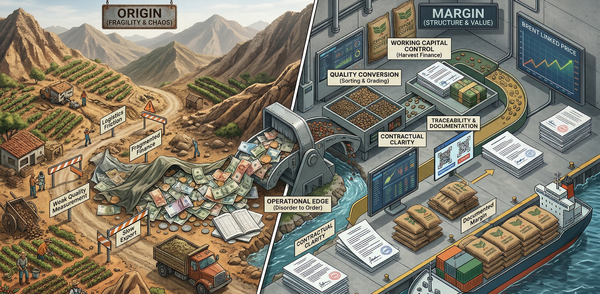
Coffee & Collectors Origin Economics: How Tier 2/3 Supply Chains Create Real, Mispriced Value Coffee value is still mispriced at origin where financing gaps, logistics friction, and contract weakness suppress margins. The edge is not speculation. It is compliant execution: structures, offtake contracts, traceability, and cash controls. By Stephanie Nelson • 6 min read
Coffee & Collectors Passion Asset Financing: When Banks Lend and When They Walk Away Banks lend on passion assets when proof is clean: title, provenance, custody, insurance, and valuation discipline. When the file is weak, lenders apply haircuts, issue margin calls, or decline entirely. Financeability is engineered, not assumed. By Stephanie Nelson • 4 min read
Coffee & Collectors Turning Culture Into Legacy: How Collectors Build Inheritable Portfolios Collectibles become inheritable wealth only when they are governable: clear ownership, custody instructions, valuation discipline, and a transfer-ready file. Without proof, heirs face probate delays, forced sales, and tax disputes. By Stephanie Nelson • 3 min read
Coffee & Collectors Coffee, Collectibles, and Culture Assets: The New Tax & Proof Standard Coffee lots, art, watches, and culture assets now live inside a proof-first world: KYC, tax reporting, sanctions screening, and registry logic. If it cannot be documented, it cannot be financed, insured, transferred, or defended. By Stephanie Nelson • 5 min read