

The contract was signed in the cloud. The tax presence was not.
Aya’s company sells B2B services across borders. No warehouses. No office leases. A distributed team and a clean digital workflow. When the company entered a new market, Aya did what most remote-first leaders do: she hired one strong local seller, asked them to “open doors,” and kept everything else centralized.
Deals started closing. The seller negotiated scope and pricing on calls, then sent contracts “for signature” to headquarters. Aya felt safe because the final signature happened at HQ.
Six months later, a local advisor asked a question that changed the tone: “Who played the principal role leading to the conclusion of those contracts, and did those contracts routinely close without material changes?”
That is not a theoretical question. It is directly tied to how PE exposure can arise under modern treaty interpretation. The OECD’s BEPS Action 7 work addresses strategies used to avoid PE status, including commissionnaire arrangements and dependent-agent patterns, and provides examples where a local person plays a principal role leading to contract conclusion.
PE risk is not just for multinationals. It is for any remote-first business that scales into countries through people
MARKET & CAPITAL REALITY CHECK
What counts as a PE, and why “remote” makes it easier to trigger by accident
The baseline definition
The OECD Model Tax Convention defines a permanent establishment as “a fixed place of business through which the business of an enterprise is wholly or partly carried on.” That definition is the starting point. The modern risk is how easily remote operating patterns can satisfy parts of it.
Three PE types that catch remote businesses
1) Fixed place PE: an office, branch, or place of management, but also potentially a place that is at the enterprise’s disposal via consistent use.
2) Dependent agent PE: local people who habitually conclude contracts, or play the principal role leading to conclusion, can create PE exposure under many treaty interpretations post-BEPS Action 7.
3) Services PE (where relevant): many treaties, often influenced by UN Model approaches, include a services PE concept based on furnishing services in a country through employees or other personnel for a time threshold.
A strong Tier 2/3 example is Saudi Arabia. ZATCA’s publication on taxation of permanent establishments discusses service PE concepts in DTAs and highlights common thresholds, including 183 days in any 12-month period in many Saudi treaties.

Remote work and home-office PE got clearer in 2025
The OECD’s 2025 Update to the Model Tax Convention includes detailed commentary on cross-border working arrangements and when a home or other relevant place could constitute a fixed place PE. It emphasizes facts and circumstances, a degree of permanence, and that using a place should not automatically mean it is a place of business of the enterprise. It also introduces a practical reference point in this context: a home or relevant place would generally not be considered a place of business of the enterprise if the individual worked from that place for less than 50% of their total working time for the enterprise over a 12-month period, with exceptions anticipated to be rare.
This matters because the work pattern, not the office lease, is increasingly what gets examined.
THE PLAYBOOK
Three scenarios and a mitigation system you can implement
Who this playbook is for:
- remote-first businesses selling cross-border
- startups expanding via local sellers and contractors
- founders who travel and make decisions on the move
- CFO and legal teams building scalable controls
Conditions that need to be true:
- you will prioritize clarity of authority and contracting
- you will track duration and activity by country
- you are willing to formalize operating protocols
Scenario 1: The sales rep who “does not sign” but closes
If a local person plays the principal role leading to contract conclusion and the contract is routinely concluded without material modification, the risk is that treaty dependent-agent logic is satisfied even if signature happens elsewhere.
Mitigation controls:
- explicit limits on authority in contracts and job descriptions
- documented approval workflows showing material review at HQ
- pricing and key terms set and approved centrally, with evidence
- training to prevent “side letters” and local commitments
Scenario 2: The roaming executive creating a place of management
Founders often do senior work while traveling: strategy, vendor negotiations, hiring approvals. When that activity becomes regular and locally anchored, it can start to look like management activity in that location.
Mitigation controls:
- board and exec decision protocols that define where major approvals occur
- travel rules for high-risk roles (contract signing, negotiation authority)
- documented meeting cadence and minutes stored centrally
Scenario 3: Long-term contractors who behave like employees
Contractors can function as “other personnel” for service PE tests in some treaty contexts, and long durations strengthen the story that the business is being carried on locally.
ZATCA’s PE guidance discusses the service PE framework in treaties and the relevance of duration thresholds.
Mitigation controls:
- clear contractor scope and deliverables, no implied authority
- review of physical presence duration by country
- consider an Employer of Record (EOR) or local entity when thresholds are likely to be crossed
The PE Red Flag Matrix (quick diagnostic)
Score each factor 0 to 3:
- Role: back office vs revenue-generating vs management
- Authority: no authority vs negotiates terms vs effectively binds the enterprise
- Duration: intermittent vs sustained vs threshold-crossing patterns
- Revenue linkage: indirect vs material vs primary driver in-country
If you see multiple 2s and 3s in one country, treat it as a governance problem now, not a tax dispute later.
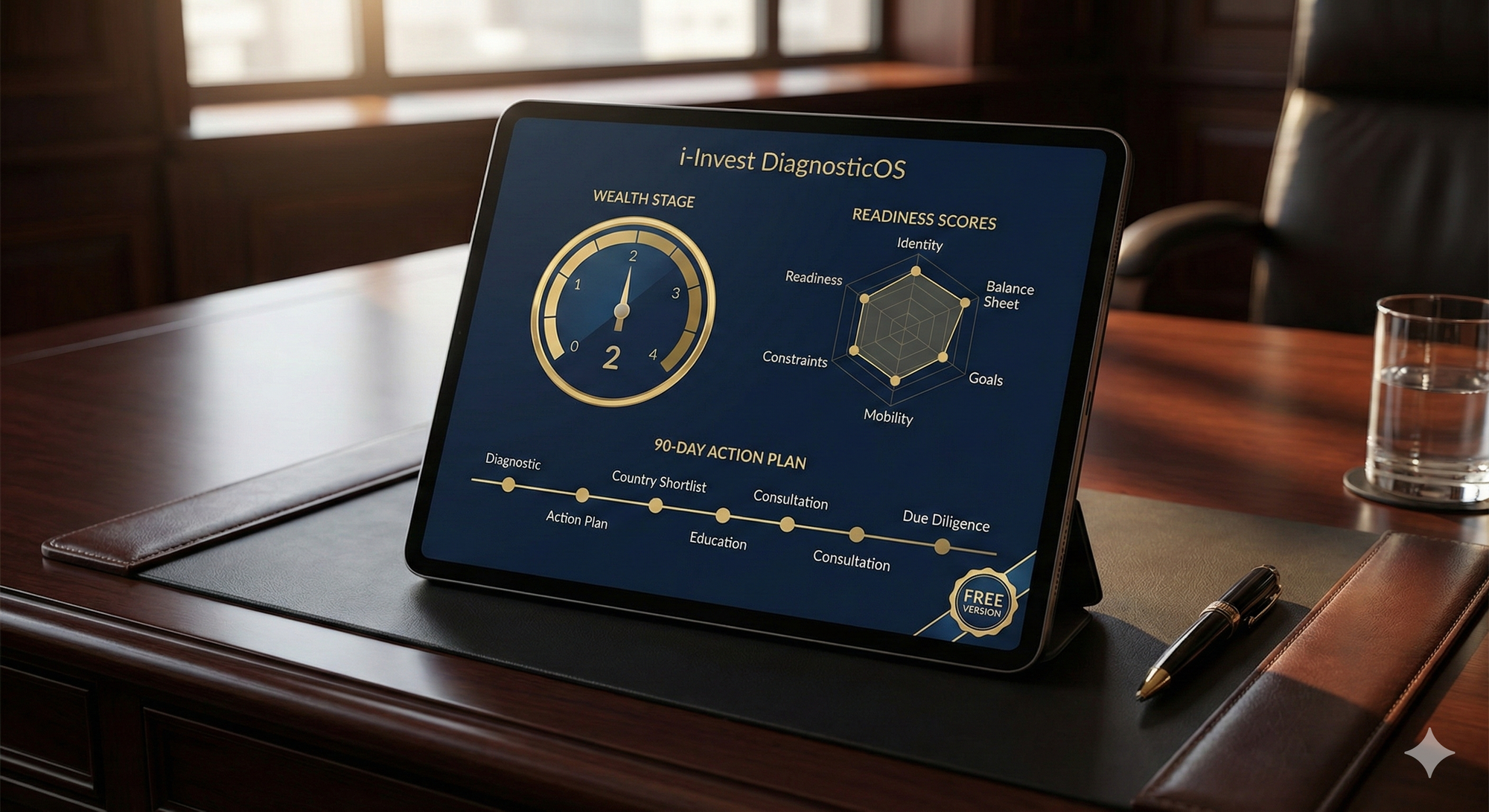
i-Invest DiagnosticOS
From diagnostic to decision-ready in minutes:
Answer a structured assessment, receive your wealth stage and risk signals, then follow a clear, personalized pathway to education, advisory, or diligence.
Remote work and home-office risk: what to document
The OECD 2025 Update emphasizes facts and circumstances and permanence, and notes that use of a home should not automatically lead to the conclusion it is a place of business of the enterprise. It also points to the usefulness of policies and contractual arrangements to the extent they correspond with actual conduct.
Practical documentation:
- remote-work policies that define permitted locations and duration
- role-based country risk tiers (sales, leadership, engineering)
- time tracking for cross-border work patterns where relevant
- evidence that major decisions and contracting remain centralized when that is the claim
Risks and frictions (do not skip):
- unexpected local corporate income tax exposure
- payroll and withholding issues
- delayed bank onboarding and heightened compliance review when a PE story is unclear
- complexity in profit attribution once PE is asserted
DEAL & PRODUCT LENS
PE management is now part of market entry strategy
PE is where legal, tax, HR, and go-to-market collide.
What companies increasingly buy:
- PE risk reviews tied to expansion plans
- contract and authority redesign (sales playbooks, approval workflows)
- remote-work policy engineering aligned to the OECD’s evolving interpretation
- local entity threshold planning (when it is time to incorporate)
The return is not a lower rate. The return is fewer surprises and faster expansion.
ACCESS & NEXT MOVES
A practical sequence for remote-first expansion
Types of actors to speak to first:
- international corporate tax advisor with PE dispute experience
- in-house counsel or external commercial counsel
- payroll/EOR provider for countries where you will hire people
Recommended sequence:
- Map roles and authority by country before you hire.
- Implement a PE Red Flag Matrix review quarterly.
- Formalize contracting protocols and approval evidence.
- Decide on local entity creation based on duration and revenue linkage, not vibes.
“Remote work did not remove borders. It moved the border test into your people.”
Key datapoints box:
- OECD Model Article 5 defines PE as a fixed place of business through which the business of an enterprise is wholly or partly carried on.
- OECD BEPS Action 7 addresses dependent-agent patterns and examples where a person plays the principal role leading to contract conclusion.
- OECD 2025 Update expands commentary on cross-border remote work, emphasizing facts and circumstances, permanence, and a practical reference point around working time when assessing home-office PE risk.
- ZATCA guidance discusses service PE thresholds in Saudi treaties, often referencing 183 days in any 12-month period depending on the DTA.
SOURCES & DISCLOSURE
Key sources used: OECD Model Tax Convention (Condensed 2017) Article 5 definition, OECD 2025 Update to the Model Tax Convention (home office and cross-border working arrangements), OECD BEPS Action 7 final report, ZATCA publication on taxation of permanent establishments (service PE concepts).
Standard I-Invest disclosure: This article is for informational purposes only and does not constitute investment, legal, tax, or migration advice. Readers should seek independent professional advice.
Written by