
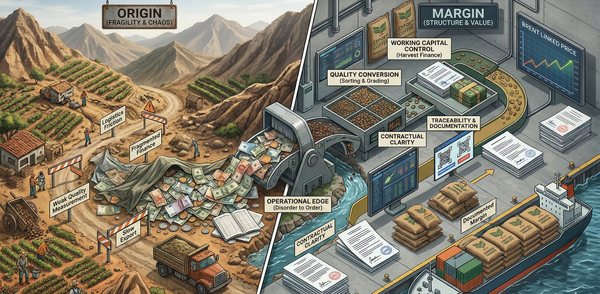
Origin is where margin hides, and where mistakes get expensive
In coffee, origin economics is often discussed but rarely underwritten with enough discipline. For investors and operators looking at Tier 2 and Tier 3 markets, the opportunity is not simply that coffee is grown far from end buyers. It is that a meaningful share of value creation happens closest to production, in environments where structural friction can distort pricing, weaken documentation, and raise execution risk.
That friction can create opportunity. It can also destroy returns.
At origin, production is often fragmented across smallholders, harvest finance is uneven, quality measurement is inconsistent, logistics can be unreliable, export processes may be slow, and currency conversion can trap working capital at the wrong moment. These frictions suppress price discovery and can create mispricing. But mispricing alone is not an edge. The edge comes from converting operational disorder into compliant, documentable, bankable margin.
What origin economics actually means
This is not a moral argument about who deserves more value in the supply chain. It is a market map. In coffee, value is not always captured where production risk, labor intensity, and operational uncertainty are highest. The commercial question is whether an investor or operator can build a structure that captures part of that trapped value without creating new fragility.
International market bodies, including the International Coffee Organization, have long documented how value distribution across the coffee chain can leave origin with a smaller share than downstream segments. FAO has also highlighted coffee price volatility and the importance of benchmark-linked price movements. International Trade Centre market resources reinforce the scale of coffee as a globally traded commodity. Taken together, these are not just background facts. They help explain why origin can be commercially attractive, but only for participants with strong operating controls.
Where returns at origin really come from
The common description of origin economics is too simple: buy low, sell high. That is not a serious underwriting framework. In practice, durable returns at origin usually come from converting friction into margin.
The first lever is quality conversion. Relatively small gains in sorting, drying, storage discipline, lot separation, and cupping consistency can move coffee from undifferentiated pricing toward specialty or relationship-based premiums. The return is not created by narrative. It is created by measurable process improvement. That means traceable lots, standardized grading protocols, documented quality records, and buyer acceptance criteria embedded in contracts.
The second lever is working capital control at harvest. Harvest is the moment when producers need liquidity and buyers with deployable capital can secure reliable supply. This is also where weak operators fail. Undocumented advances, informal side payments, poor collateral practice, and cash-heavy workflows may work in the short term, but they do not survive audit, lender diligence, or institutional scale. If the capital stack cannot pass a compliance review, the strategy is not truly scalable.
The third lever is logistics and export execution. Margin is often lost not in procurement, but in warehousing, shipment timing, export documentation, and cost overruns such as demurrage. Coffee origin strategies frequently fail because investors underestimate the operational value of shipment discipline and document accuracy. Logistics is not a back-office function here. It is a core margin-defense mechanism.
The fourth lever is contractual clarity. A surprising amount of origin value is lost because contracts leave too much open to interpretation. If quality specifications are vague, pricing formulas are loose, delivery terms are unclear, or dispute resolution is missing, value leakage becomes highly likely. Institutional underwriting requires enforceable rights, not relationship-based assumptions.
The institutional capital reality check
Any credible origin model has to answer five basic questions.
First, where does the cash come from? Is the capital coming from sponsor equity, inventory finance, trade finance lines, customer prepayment, or a structured advance against confirmed offtake? The answer affects both return expectations and failure risk.
Second, in what currency does the risk sit? Coffee may be priced against international benchmarks, but procurement, labor, storage, transport, and local taxes may sit in local currency. That creates basis risk, FX convertibility risk, and timing mismatches between operating cash outflows and export proceeds.
Third, under what legal setup does the model operate? A local operating company may buy cherry or parchment, process it, and warehouse inventory. A separate exporter may hold export licenses and manage title transfer. An offshore trading or finance entity, if used, should have a genuine commercial function with corresponding documentation. If structure and substance do not match, banks and counterparties will eventually challenge it.
Fourth, what is the plausible return range? Origin economics should not be marketed as a guaranteed premium strategy. Returns may come from quality uplift, faster inventory turns, better procurement timing, reduced rejection rates, lower logistics leakage, or better contract execution. But these depend on assumptions that can fail. A serious piece should frame returns as operationally contingent, not assured.
Fifth, what can go wrong? Currency controls, shipment delays, quality disputes, documentary errors, regulatory bottlenecks, uninsured losses, local counterparty weakness, and enforcement challenges can all compress or eliminate margin.

Global Wealth Diagnostic
The Global Wealth Diagnostic is a fast, personalized assessment that helps high earners identify the smartest next steps for building wealth across borders. It evaluates your current position, highlights your biggest opportunities and gaps, and gives you a practical roadmap for investing, structuring, and moving with more confidence.
A compliant origin execution model
For origin economics to be investable, the operating model has to survive scrutiny from banks, auditors, counterparties, and regulators.
1. Structure the activity to match reality
The first rule is simple: form should follow function. Local procurement, processing, warehousing, export, and financing should be allocated to the entities that actually perform them. An offshore entity should not exist only to collect margin without real decision-making, contractual responsibility, or commercial substance. Fragile structures may work in presentation decks, but they fail when lenders test substance, payments teams review flows, or disputes require documentary proof.
2. Draft contracts as if an institutional lender will review them
Minimum documentation should include a clear lot definition, traceability standard, quality testing and acceptance process, pricing method, delivery terms, transfer of title and risk, payment terms, permissible deductions or set-offs, governing law, dispute forum, and compliance representations. Where sanctions, anti-bribery, or trade controls may be relevant, those representations must be explicit.
The principle is straightforward: if you want to capture origin margin, you must be able to prove what was purchased, how it was graded, when title transferred, and why the payment terms were commercially justified.
3. Build payment hygiene from the start
Many origin strategies do not fail because of overt fraud. They fail because of informal habits that make them impossible to finance at scale. Counterparty onboarding files, documented payment flows, reconciliation discipline, approval controls, and auditable inventory accounting are not administrative extras. They are the foundation of financeability.
4. Treat traceability as both a compliance tool and a pricing tool
Traceability is no longer just a reporting exercise. It can support premium pricing, reduce lot-identity disputes, and improve downstream diligence readiness. It also becomes a defensive asset when a buyer challenges quality, a lender reviews collateral, or an insurer asks for evidence after a loss event.
5. Underwrite country and market risk as a system
Tier 2 and Tier 3 origin strategies need a system view of risk. That means assessing FX convertibility, export licensing requirements, documentary pathways, dispute resolution practicality, logistics redundancy, insurance adequacy, and claims readiness before capital is deployed. Mispriced value only matters if proceeds can be realized and repatriated without undue friction.
What can break the model
Origin economics becomes dangerous when the article or investment memo romanticizes production but underestimates execution. The main failure paths are usually mundane.
Quality premiums can disappear if measurement standards are inconsistent. Harvest finance can become unrecoverable if advances are undocumented or recovery rights are weak. Gross margin can be eroded by warehouse losses, delayed shipments, or export documentation failures. FX moves can compress local purchasing power or trap liquidity. Contracts can become functionally useless if enforcement is slow or governing law does not align with the transaction pathway. A strategy that appears profitable on paper can become unbankable if cash handling, title transfer, and reconciliation are poorly documented.
What Origin Dealflow Notes should include
Readers do not need a romantic story about farms. They need an underwriting lens.
A useful origin dealflow note should identify where margin is created, whether through quality conversion, working capital timing, logistics discipline, or contractual advantage. It should explain what must be proven, including traceability, title transfer, inventory integrity, and payment documentation. It should map what can break, especially around FX, export paperwork, disputes, and compliance. It should describe the structure in plain terms and explain why the legal and operating model matches commercial reality. Finally, it should show what the documentation pack looks like, because in origin markets, the distance between a promising trade and a financeable one is often the quality of the paper trail.
Sources
- International Coffee Organization, materials on coffee value chain economics and value distribution
- FAO, coffee price dynamics and benchmark-linked market movements
- International Trade Centre, coffee market and trade resources
Before publication, replace these with full source citations, titles, publication dates, and access dates.
Disclosure
This article is general information, not personal investment, tax, or legal advice. It reflects conditions and data available as of March 2026. I-Invest Magazine and the author do not receive compensation from entities mentioned unless explicitly stated. Readers should obtain independent professional advice before taking action.
Written by