Digital Nomads vs. Tax Authorities: Why “Days Count” Is Not a Strategy
Digital nomads optimize calendars. Tax authorities litigate life facts. Day counts help, but housing, family, work, and records decide claimability. Here is a residency proof framework and audit-file structure that beats spreadsheet thinking.
The calendar looks clean until someone asks for receipts
Noah is a remote professional who lives in seasons. He spends spring in one country, summer in another, and autumn somewhere cheaper, quieter, and easier. He tracks days diligently. He avoids the numbers that trigger dinner-table warnings. He keeps screenshots of flights.
Then a bank asks for a CRS self-certification update, and a tax authority asks where his “centre of life” really is.
Noah assumes this is still a day-count argument. He offers the spreadsheet.
But the questions that follow are not about math. They are about life:
where is your long-term home available to you
where do you receive medical care
where do you spend most of your money
where are your closest personal relationships
where do you work, and where do you manage decisions
This is why “days count” is not a strategy. It is one input.
In the UK, HMRC’s guidance on record keeping for the Statutory Residence Test explicitly references connections such as family, accommodation, work, and time spent in the UK, and instructs individuals to keep information and records that allow them to work out where they spent days and midnights, including travel schedules, booking info, and tickets.
That is already the hint: the test is not only days. It is ties.
In Spain, the tax agency’s residency guidance states that residence can be determined by spending more than 183 days in Spain, and also by having the main core or base of activities or economic interests in Spain, directly or indirectly.
Nomad life tends to create “soft ties” everywhere. The problem is that soft ties can still add up to claimability when one country has enough evidence to assert you are theirs.
MARKET & CAPITAL REALITY CHECK
Digital nomad visas are immigration tools, not tax verdicts
A major confusion point for nomads is mixing immigration permission with tax outcomes.
Spain’s Digital Nomad Visa is positioned as a consular service for remote work in Spain, listing requirements around employment or self-employment and remote work documentation. Separately, Spain’s tax agency describes the tax-residency tests, including the 183-day presence test and the “core of economic interests” test.
Those are different systems with different purposes.
Portugal similarly lists “Remote Work / Digital Nomad” as a category within its national visas framework, which is an immigration classification. Whether you become tax resident still depends on domestic tax rules and your facts.
This split creates a practical risk: You can be lawfully present as a “digital nomad,” and still end up tax resident in a country based on days, housing availability, and economic ties.
The second risk is dual residency. If two jurisdictions can credibly assert you, you may rely on treaty tie-breakers. But treaty logic is evidence hungry. It does not reward vagueness. It rewards proof.
THE PLAYBOOK
Replace day-count thinking with a residency proof framework
Who this playbook is for:
remote workers who spend meaningful time in multiple countries
founders who roam while running teams
anyone using a nomad visa or frequent Schengen stays
advisors building audit-ready documentation habits
Conditions that need to be true:
you are willing to document truthfully
you will align paperwork with reality
you will stop treating a calendar as a shield
The Residency Proof Framework
Organize your proof into categories. Days are only one category.
1) Identity and status
passports, residence permits, visa documentation
tax identification numbers where issued
registration documents where relevant
2) Housing and availability
leases, property ownership, access logs where applicable
utility bills, insurance, proof of occupancy
evidence of where a “permanent home” is actually available to you
3) Economic life
employment agreements, client contracts, invoices
where you perform the work, and where management decisions happen
evidence of where your economic interests are centered
Spain explicitly includes an “economic interests” test in its residency criteria.
4) Personal ties and routine
partner and dependents’ location
school calendars, where relevant
healthcare usage patterns
memberships and other evidence that shows habitual routine
5) Financial behaviour
bank statements showing spend patterns
recurring payments that reveal where life is administered
consistency between bank proof-of-address and your declared tax residence
6) Travel proof (supporting, not leading)
tickets, boarding passes, entry and exit stamps
itineraries and booking confirmations
a day log with midnights, not just arrivals
HMRC explicitly advises keeping records that enable calculating where days and midnights were spent, including tickets and booking information.
The “audit file” folder structure
Create a digital folder for each tax year:
01 Identity and permits
02 Housing
03 Work and income
04 Family and routine
05 Financial behaviour
06 Travel and days
07 Correspondence (banks, authorities, advisors)
If a question arises, you are not searching email for months. You are producing a coherent file.
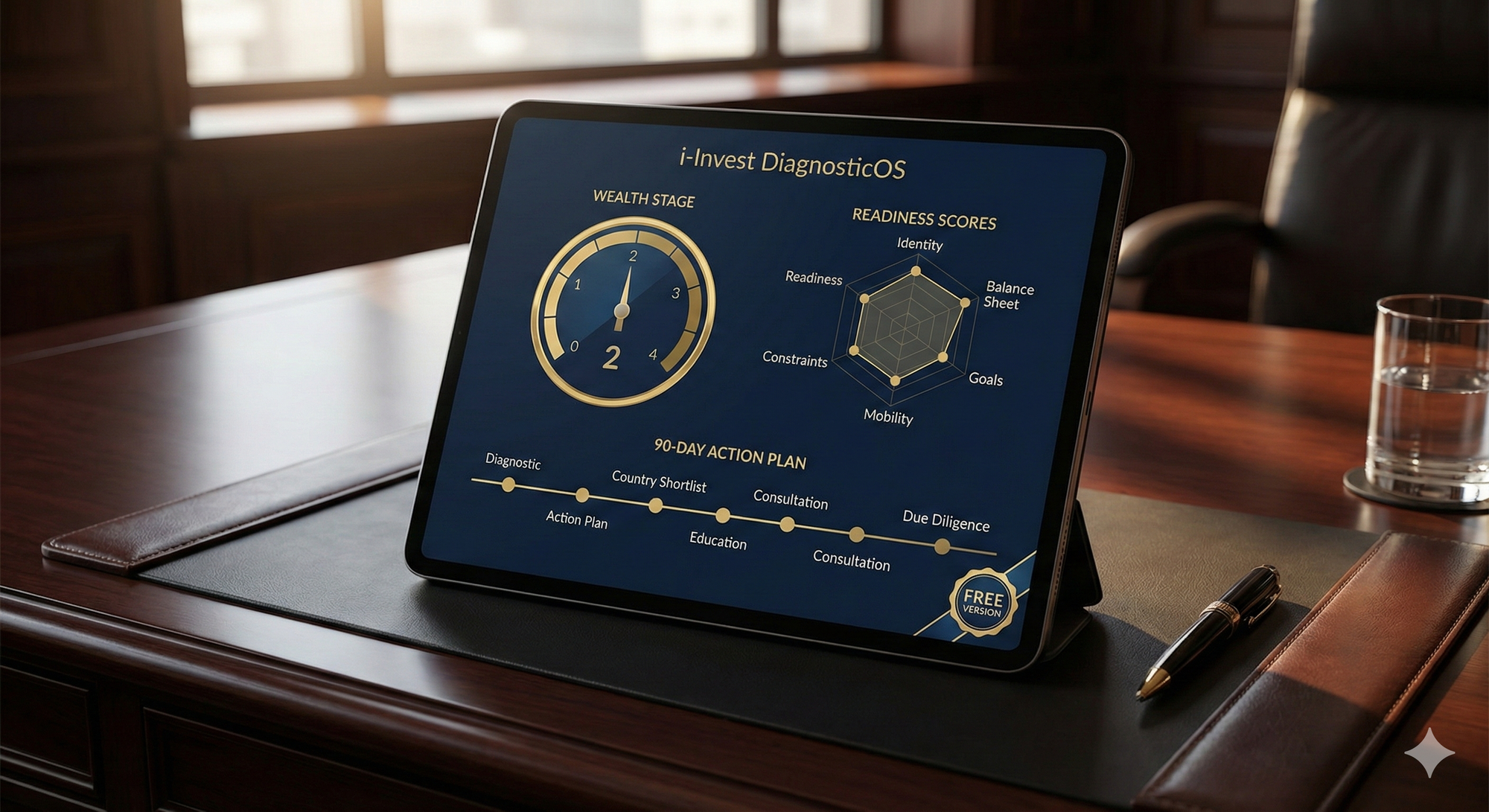
i-Invest DiagnosticsOS
From diagnostic to decision-ready in minutes: Answer a structured assessment, receive your wealth stage and risk signals, then follow a clear, personalized pathway to education, advisory, or diligence.
Nomad success is evidence management and consistency
Nomad culture often sells freedom. The durable version adds systems:
residency proof frameworks and annual evidence capture
cross-border tax filing coordination when facts trigger it
banking readiness packs for frequent movers
family mobility planning where dependents anchor residency narratives
The strongest operators do not try to disappear. They stay legible.
ACCESS & NEXT MOVES
Build a proof posture before you need it
Types of actors to speak to first:
cross-border tax advisor familiar with residency disputes
immigration counsel for visa and permit pathways
banking compliance-aware advisor if you maintain multiple accounts
Recommended sequence:
Map your real life pattern, not your preferred story.
Build the audit-file folder structure now.
Align bank self-certifications and addresses with what you can prove.
Review annually, especially after a move, relationship change, or new long lease.
“Days are countable. Life is claimable.”
Key datapoints box:
HMRC guidance for the SRT record keeping references ties such as family, accommodation, work, and instructs individuals to keep records like tickets and booking information to work out days and midnights.
Spain’s tax agency lists both the 183-day presence test and the “core of economic interests” test as bases for tax residence.
Spain’s Digital Nomad Visa is presented as an immigration service with its own document requirements, separate from tax-residency determinations.
Portugal’s national visa framework lists Remote Work / Digital Nomad as a visa type, which is an immigration classification.
Key sources used: HMRC Residence and FIG Manual record-keeping guidance, Spain Agencia Tributaria residency guidance (including Art. 9 IRPF references), Spain consulate Digital Nomad Visa page, Portugal national visas “type of visa” page listing remote work/digital nomad.
Standard I-Invest disclosure: This article is for informational purposes only and does not constitute investment, legal, tax, or migration advice. Seek independent professional advice.
Founder of I-Invest Magazine. She builds global wealth systems linking private credit, real estate, and mobility pathways that turn high-income professionals into institutional investors with generational impact.