Building a Family Constitution: Education & Governance for Intergenerational Success
By John Morris De Bellotte & I-Invest Magazine

– 4 min read

By John Morris De Bellotte & I-Invest Magazine

Academic research consistently shows that passing a business and wealth to heirs is difficult. A 1981 MIT working paper by Beckhard and Dyer found that only about 30% of family firms survive into the second generation, while John Ward’s study revealed that only 13% maintain majority family ownership into the third.
These figures, often simplified as a “70% failure rate,” point to a deeper truth: continuity becomes harder as families grow. The challenge is rarely financial performance alone—Harvard Business School notes that many family business failures stem from internal conflict rather than market forces.
Quote:
“Legacy without governance is luck; legacy with education is leadership.”
Without agreed-upon rules for decision-making, misunderstandings can unravel even the strongest legacies.
The Role of a Family Constitution
A family constitution—sometimes called a charter—is a governance document that codifies a family’s values, decision-making processes, and conflict-resolution mechanisms. Research shows that such frameworks help balance family and business interests, ensuring smoother succession and stronger cohesion.
Though not legally binding, a well-crafted constitution sets expectations for ownership, participation, and leadership succession—creating clarity where ambiguity once bred tension.
Quote:
“Without agreed rules, misunderstanding becomes inheritance.”
Quote:
“Treat your constitution as a living document, not a family relic.”
A family constitution should evolve over time—review it regularly to reflect changes in membership, wealth, and purpose.

The most overlooked aspect of succession is education. Studies show that unclear criteria for family involvement often harm both business and relationships. Leading families address this by requiring heirs to gain degrees or outside experience before entering management.
Practical steps include:
• Teaching financial literacy early.
• Involving young members in councils or committees.
• Offering internships and mentoring.
• Encouraging transparency from senior members.

Travel & Invest Global is the concierge partner of choice for high earners who want their passport, portfolio, and lifestyle working in the same direction. This sponsorship spot connects readers to a white glove advisory platform that designs end to end global wealth and mobility strategies, from second residency routes and tax efficient structures to curated property and private market deals in Tier 2 and Tier 3 countries. Travel & Invest Global helps serious wealth builders relocate or dual base with confidence, reduce tax drag, unlock passive income, and turn “where you live” into a strategic asset, not just a personal preference.
Quote:
“Education transforms inheritance into stewardship.”

Such practices build both capability and humility—essential traits for responsible leadership.
Quote:
“Family wealth endures when purpose is shared and knowledge is passed on.”

The statistics are sobering—but not destiny. Only 30% of family firms survive to the second generation, and just 13% to the third. Families who combine structured governance with intentional education dramatically increase their chances of long-term success.
By articulating shared purpose, formalizing decision-making, and preparing the next generation, today’s families can turn legacy into leadership—transforming wealth into wisdom that endures.
Quote:
“When values are written, and wisdom is taught, a legacy becomes a dynasty.”

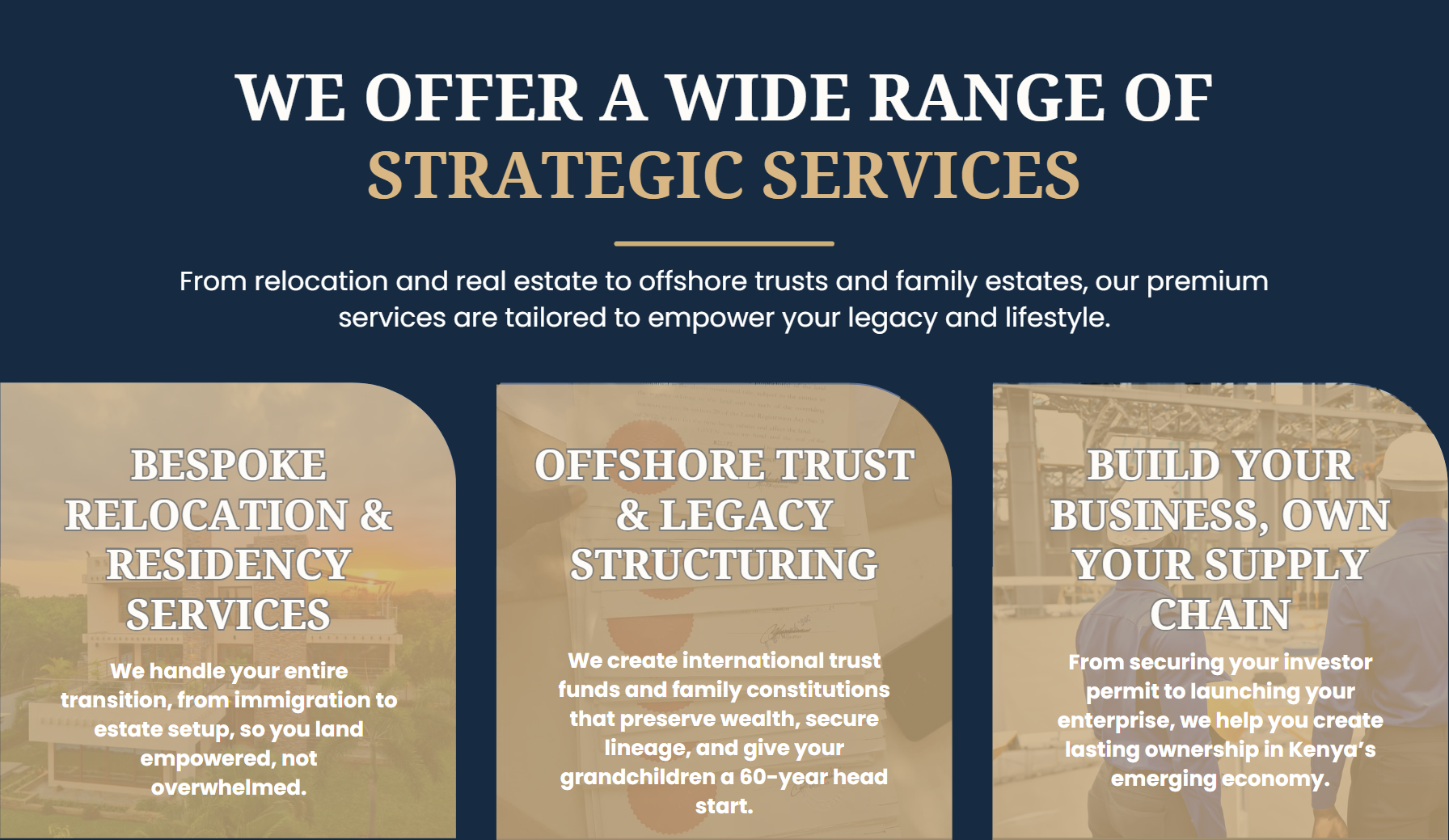
From relocation and real estate to offshore trusts and family estates, our premium services are tailored to empower your legacy and lifestyle.
John Morris De Bellotte is the founder and CEO of Diaspora Freedom Initiative, LLC, a specialist advisory platform for generational wealth planning, African relocation, and cross border business expansion for globally mobile families and entrepreneurs. A generational wealth strategist and trust architect, he designs multi jurisdictional structures, including Kenyan international trusts, to align asset protection, tax exposure, and legacy outcomes for diaspora clients who want to shift from high risk jurisdictions into resilient multi country portfolios. As Patriarch of the House of De Bellotte, his work sits at the intersection of family governance, offshore trust strategy, and African market entry, with a core mandate to convert geopolitical and economic risk into long horizon opportunity for the global African diaspora.
Learn More